

The first time AI turns a messy set of notes into a polished page, it feels like a productivity breakthrough. Then the review begins. A date is wrong. A proposed action is written as a decision. A source is missing. Somebody spends twenty minutes fixing what took the model twenty seconds to draft.
My move from orthopedic engineering into project management made the hidden work behind a polished deliverable more visible. A concise status update still takes source checks, follow-up, and judgment. I use that same full-workflow view when deciding whether an AI draft actually saves time.
I use AI to reduce information-processing work in technical programs. I have also learned to ask a less exciting, more useful question: Did the entire workflow get better? Drafting speed is only one part of that answer.
Start and stop the clock at the right places
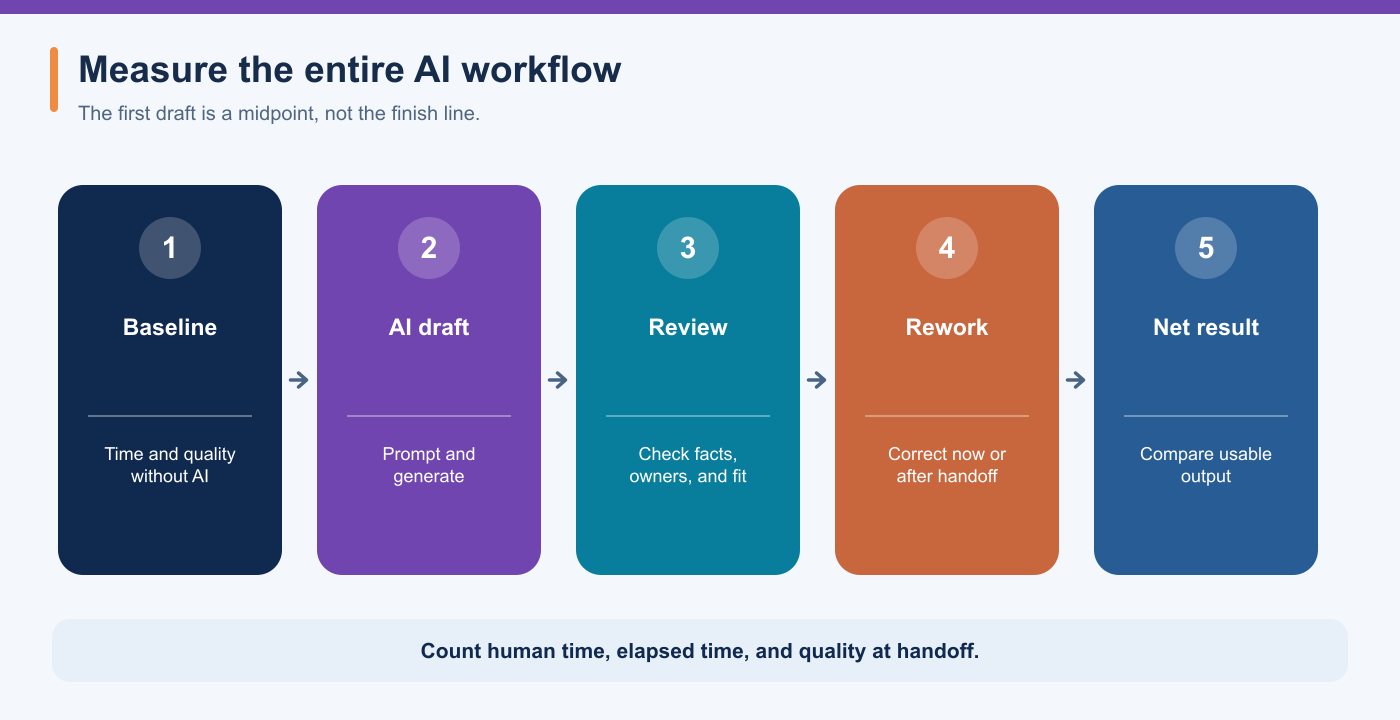
For a recurring task, compare the old workflow with the AI-assisted one from the same starting point to the same usable output. Include collecting inputs, prompting, reviewing, correcting, getting approval, and any rework discovered after handoff. If the task previously took 50 minutes and the AI draft takes 5, that does not mean 45 minutes were saved if review and correction take another 35.
Track at least three outcomes: total human time, elapsed time to a usable result, and quality at handoff. A workflow can reduce hands-on effort while increasing waiting time. It can also be faster but introduce more errors. Those tradeoffs matter differently for an internal brainstorm and a launch-readiness update.
The idea that AI gains vary by task has empirical support. In a field study of customer-support agents, researchers found an average productivity gain from AI assistance, with much larger gains for less experienced workers than for highly skilled ones. A Harvard Business School field experiment found that AI helped on some knowledge-work tasks and was less reliable on others. Neither study tells an engineering team what its own net benefit will be. It tells us to measure the specific task.
Use a small audit, not a grand transformation metric
Choose one recurring task, such as turning a project tracker into a weekly update. Run several comparable examples with and without AI. Record where time went and note any defects that reached another person. Do not change the task definition halfway through the comparison.
| What to record | Why it matters | A warning sign |
|---|---|---|
| Time to first draft | Shows where AI accelerates creation | Celebrated as the entire gain |
| Review and correction time | Captures the human work AI creates | More time spent checking than drafting |
| Downstream rework | Reveals errors found after handoff | Another team has to repair the output |
| Quality at handoff | Protects the purpose of the task | Faster output with less trust |
The table is deliberately simple. A spreadsheet with dozens of measures can become its own productivity tax. The point is to expose where work moved—not just where it disappeared from the first person's calendar.
Count the cost of being convincingly wrong
The NIST Generative AI Profile describes confabulation: generated content that confidently presents erroneous or false information. NIST's AI Risk Management Framework also emphasizes evaluating outputs in their context of use. For technical and program work, that means an elegant answer is not automatically a usable one.
I would use a lighter review for a brainstorming outline than for an executive update that could change a commitment. For a consequential output, check source support, numbers, owners, dates, and whether a suggestion has been mistaken for an approved decision. If the check takes too long, the workflow may need a narrower AI role.
That is different from the question in my earlier article on using AI in complex engineering programs. There I focus on where AI belongs. Here the question is whether it earns its place after we count the full work.
Keep the workflows that win on the outcome
The best AI use case may be unglamorous: extracting actions into a standard format, comparing two versions of a document, or identifying missing fields before a human review. If that saves time without lowering quality, keep it. If it creates a polished artifact that requires extensive repair, change the prompt, narrow the task, or do that step without AI.
Productivity is not how quickly a tool produces words. It is how reliably a team reaches a useful result with less effort and fewer surprises.
For a concrete example of turning AI output into a useful communication workflow, see How to Turn Meeting Notes Into Executive Updates With AI.
If you are testing AI in a technical workflow and want to separate genuine savings from hidden rework, contact me. I enjoy mapping the work before arguing about the tool.
Keep reading
- Stop Asking “Can AI Do This?” Ask “What Happens If It’s Wrong?”
- Not Everything Needs AI: What Building a Form-Filler Taught Me About When Software Still Wins
Free for subscribers
The Engineer-to-PM Starter Kit
A readiness scorecard, a first-90-days plan for new technical PMs, three templates and an AI prompt pack. Subscribe and the download link comes in your welcome email.

Leave a Reply