
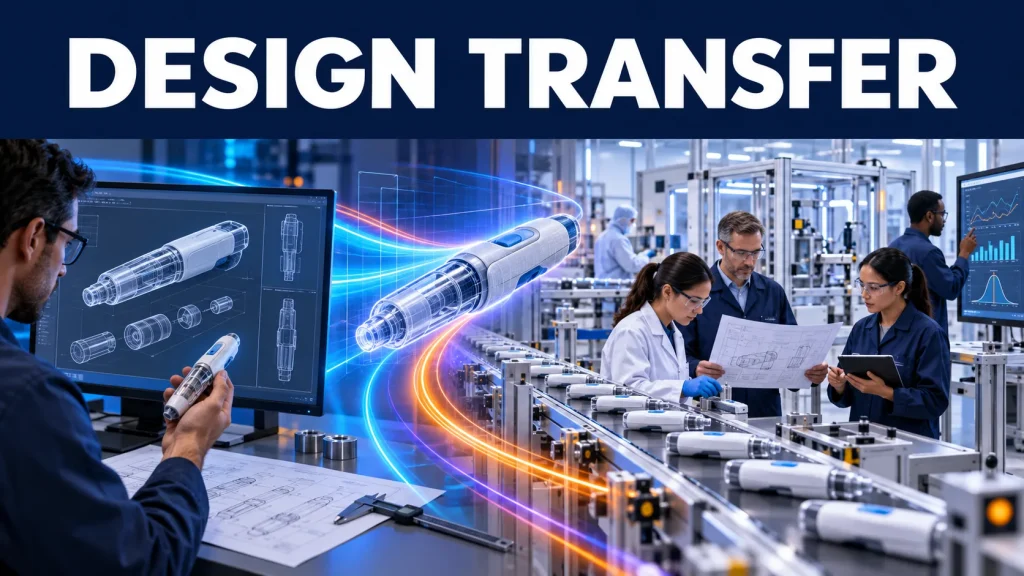
The prototype on an engineer's bench can be persuasive: it fits, moves, and performs. But production asks a harder question. Can another team build the same thing repeatedly, inspect it consistently, and know what to do when reality differs from the drawing?
That transition is design transfer. Under ISO 13485:2016, the process is part of design and development. The FDA's current training module explains that design outputs must be verified as suitable for manufacturing before becoming final production specifications, and that production capability must be able to meet product requirements.
A drawing is necessary, but rarely sufficient
A drawing tells a machinist or supplier what the design is meant to be. It may not fully capture how to hold a difficult feature, which characteristics are critical, how an assembly is checked, or what to do when a material lot behaves differently. The team may also need specifications, work instructions, inspection methods, tooling, training, supplier controls, and a route for handling deviations.

Take a hypothetical surgical instrument. An engineer can assemble a few prototype units by hand and make them work. If production needs a special adjustment that is not in the controlled process, the apparent design success is not yet repeatable. The question is whether the process—not one expert's touch—can deliver the required output.
Transfer starts before the final handoff
Operations and quality should see the design while it is still flexible. Their questions can expose a tolerance that is hard to inspect, a feature that is costly to machine, or an assembly step that depends on judgment. A late discovery can trigger redesign, new tests, and schedule changes. An early discovery can become a sensible design input.
In my work across engineering and program leadership, the most useful transfer meetings were not status recitations. They asked what evidence each function needed to accept the next step. Engineering needed confidence in design intent. Manufacturing needed a stable process definition. Quality needed a way to verify it. Program leadership needed the dependencies and decisions visible.
What “ready” should mean
Readiness is product-specific, but a practical review can ask:
- Are the design outputs complete enough to build and inspect the product?
- Have the relevant verification and validation questions been resolved or explicitly controlled?
- Can the production process meet critical requirements consistently?
- Are suppliers, tooling, training, and inspection methods prepared?
- Does a change in production flow back to the design and risk decisions?
An answer of “not yet” is useful if it comes early. It allows a team to fix the gap rather than discover it in the first commercial lot.
| Handoff | What the receiving team needs | Readiness evidence |
|---|---|---|
| Design to manufacturing | Complete outputs and critical characteristics | Reviewed specifications and build instructions |
| Manufacturing to quality | A process and a way to inspect its output | Capability and inspection results |
| Production to program team | Known dependencies and variation routes | Agreed owners, records, and escalation path |
The broader lesson
Software teams experience design transfer when a prototype becomes a reliable service with deployment, monitoring, support, and incident response. Hardware startups experience it when a hand-built device meets real supplier lead times and process variation. The documentation will differ; the central question does not: Can the organization deliver the promised behavior without relying on the person who built the first prototype?
Design transfer is not the paperwork after innovation. It is where innovation becomes repeatable.
Before transfer, revisit The Hidden Cost of a “Small” Design Change: controlled drawings and process instructions must reflect the decisions the team actually approved. Verification vs. Validation helps clarify which evidence supports the handoff.
If you are moving a technical product from prototype into a program or production environment, contact me. I would be happy to discuss the handoffs that deserve attention first.

Leave a Reply